A parent wants their 15-year-old’s therapy records. Can you send them?
ReleaseRight walks you through any records request for a minor patient and tells you what you can release, what you must hold back, and who has to sign. Every answer cites Florida and federal law, and the response letter is written for you.
No card needed. Built for Florida LMHCs, LCSWs, LMFTs, and psychologists.
Every request ends in one of five answers
- ReleaseThe requester is entitled to the record.
- Release with redactionsSend it, minus the parts the law protects.
- Hold for documentsGet the court order or authorization first.
- Hold for legal reviewFlorida law is unsettled here. Ask counsel.
- WithholdThis person has no right to the record.
Florida law pulls in four directions at once
Parents have a statutory right to their child’s medical records. Teenagers 13 and older can consent to some crisis sessions on their own. Substance use records need the minor’s written consent, even to a parent. Psychotherapy notes, family members mentioned in session, divorced parents, guardians ad litem, and subpoenas each add their own rules.
Get it wrong in one direction and you hand a teenager’s private sessions to the wrong person. Get it wrong in the other and you face a board complaint from a parent who had every right to the file. Most solo practitioners make this call alone, under a 30-day deadline, with no records department to ask.
How it works
-
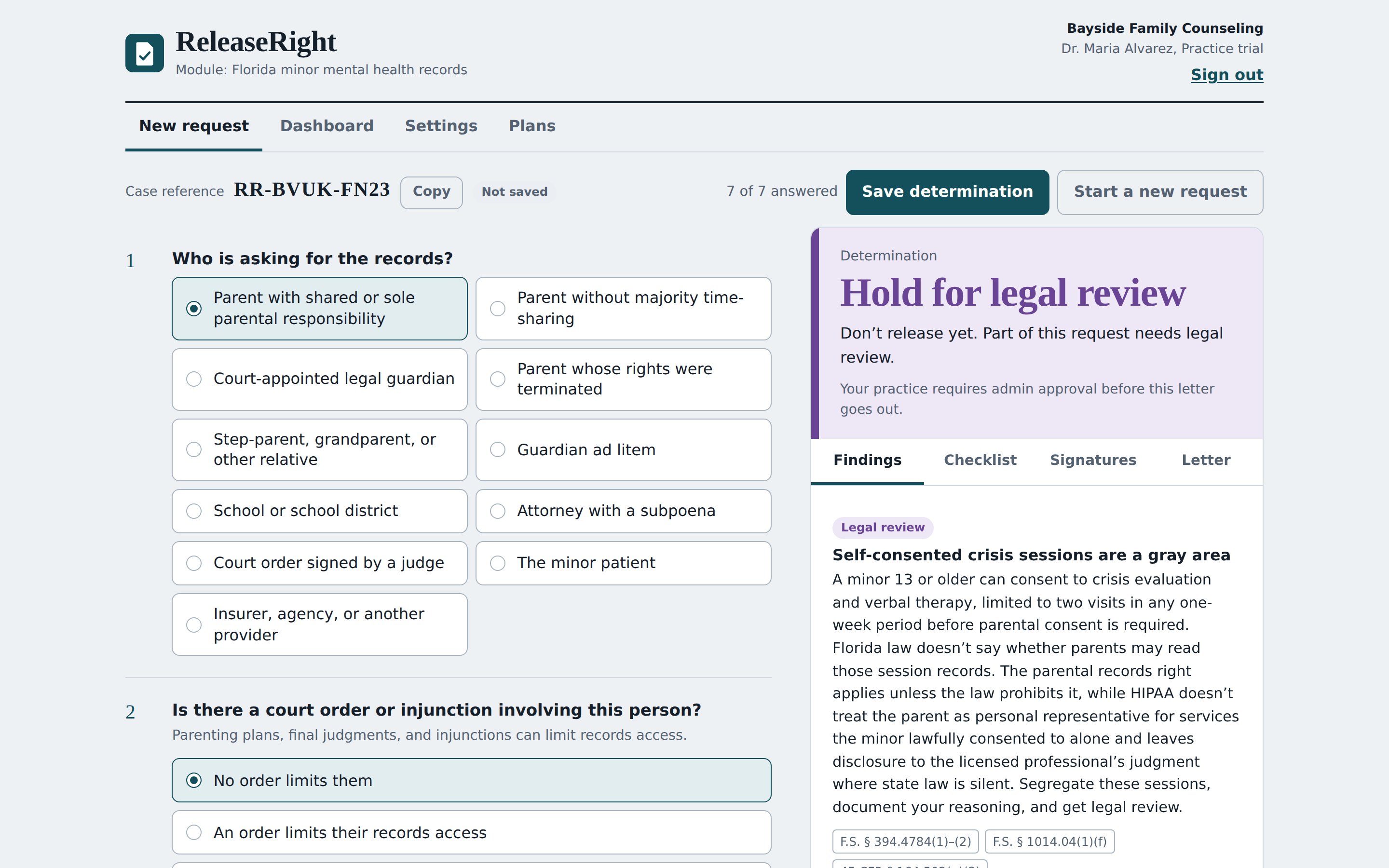
Answer a few questions about the request
Who’s asking, whether a court order is involved, the minor’s age, how treatment was consented to, and what the record contains. Every answer is a choice from a list, so there’s nothing to type and no patient names to enter.
-
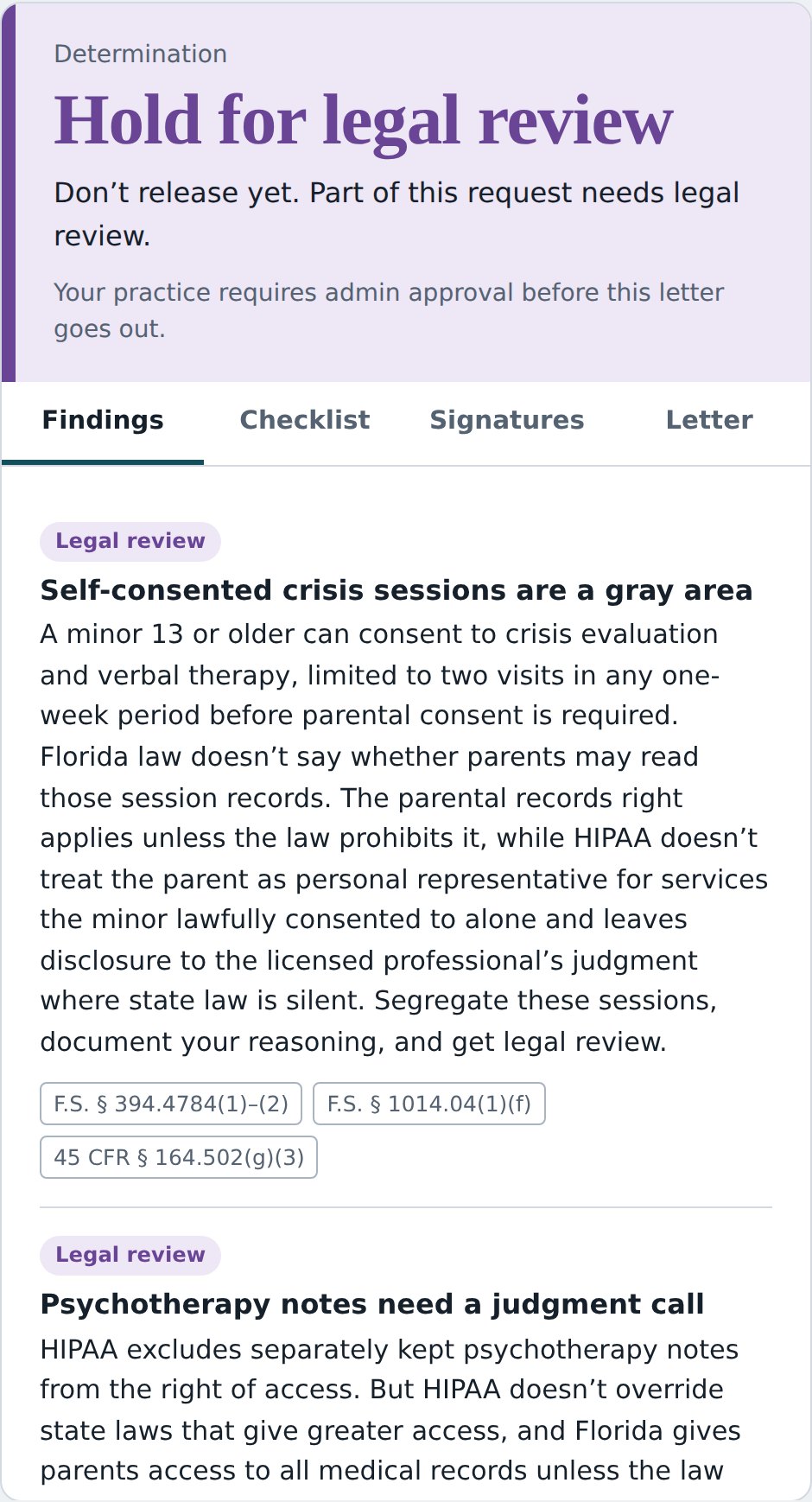
Read the determination and why
The answer updates as you go. Each finding explains the rule in plain language and lists the statutes behind it, so you can see exactly why a record can go out or has to stay in the chart.
Alongside the findings you get a redaction checklist for your EHR export and a list of everyone who needs to sign.
-
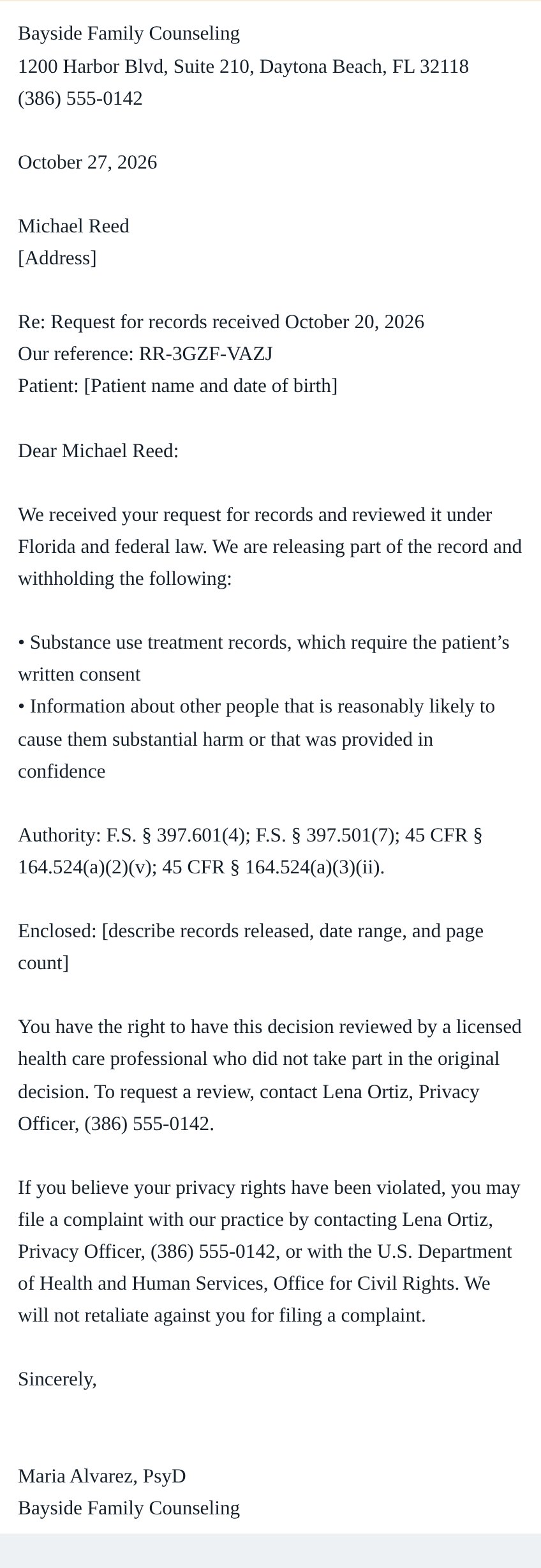
Send the letter
ReleaseRight writes the right response for the outcome: a release cover letter, a partial denial with the patient’s review rights, a request for missing documents, or a privilege objection to a subpoena. It’s on your letterhead and ready to download as a PDF.
Save the determination and it goes into your practice’s audit log, tied to a case reference you paste into the chart.
Covers the requests you actually get
Parents with shared or sole responsibility, parents without majority time-sharing, parents whose rights were terminated, step-parents and grandparents, legal guardians, guardians ad litem, schools, attorneys with subpoenas, judges’ orders, insurers, other providers, and the minor patient.
Grounded in the law that applies
Florida’s Parents’ Bill of Rights, the parenting plan statute, minor consent for crisis services and substance use treatment, licensure confidentiality for chapters 490 and 491, the psychotherapist–patient privilege, the HIPAA Privacy Rule, and 42 CFR Part 2. Every saved determination records which version of the rules it used.
For group practices: one place to see every decision
When a board complaint or a subpoena arrives months later, you can show what was decided, by whom, under which version of the law, and who approved it.
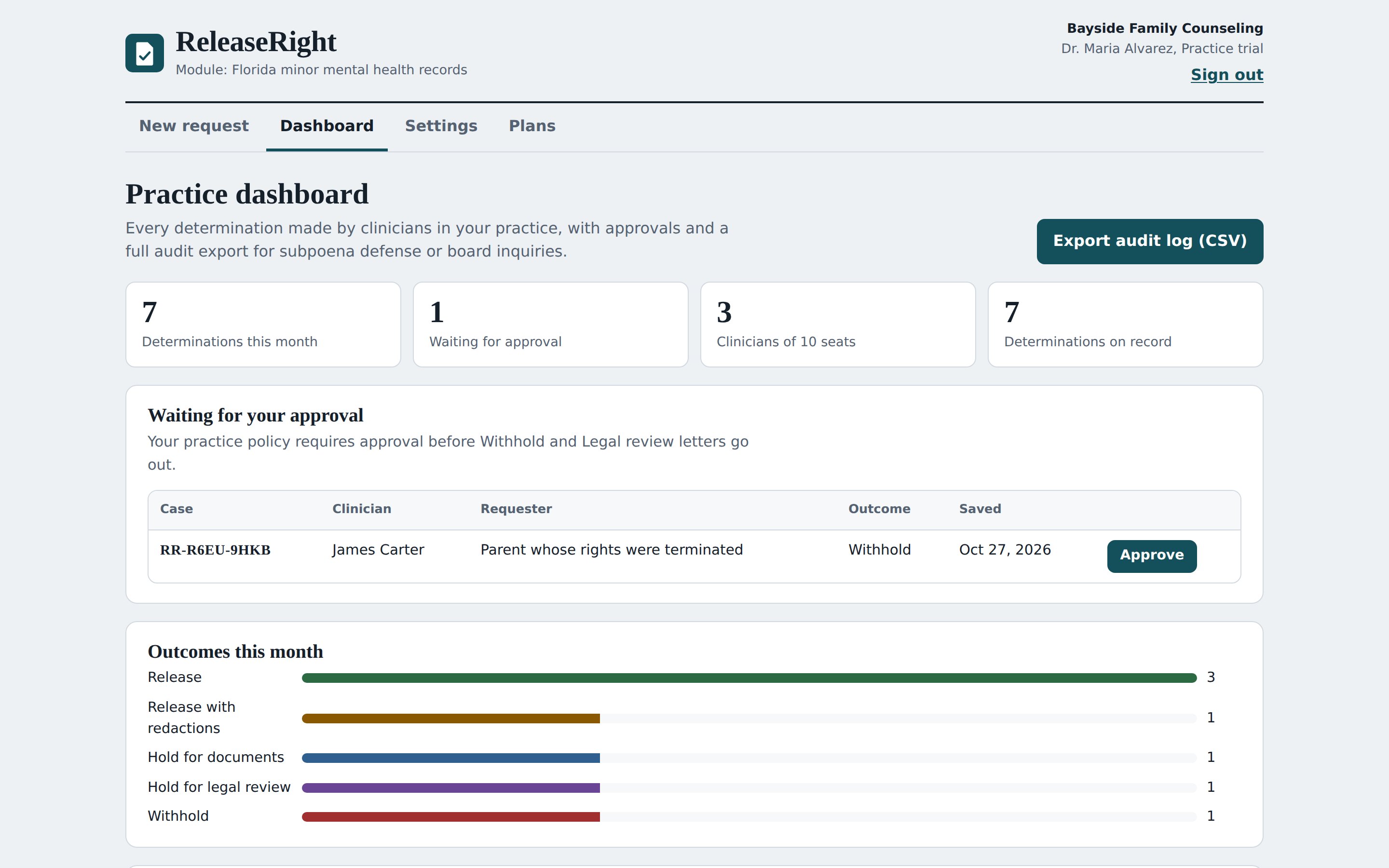
- Approval workflow. Require an admin to approve Withhold and Legal review outcomes before the letter goes out.
- Audit log export. A complete, append-only record of every determination and change, as a spreadsheet.
- Practice policies. Set a standing approach your attorney has advised, and every clinician sees it labeled as practice policy.
- Your letterhead. Logo, address, and privacy contact on every letter from every clinician.
ReleaseRight never sees your patients
A saved determination holds a random case reference, your multiple-choice answers, the outcome, and who made it. No names, dates of birth, or record contents. The requester’s name and the letter text stay on your screen and are never sent to us.
You paste the case reference into your chart, so only your EHR can connect a determination to a patient. Our servers reject anything that isn’t one of the listed choices, so free text can’t be saved even by accident.
One price per practice
Every plan includes the full triage engine, every letter type, PDF downloads, and rule updates when the law changes. Start with 14 days of the Practice plan, free.
Starter
$29 a month
or $290 a year
- 1 clinician
- 5 determinations a month
- All letter types and PDF downloads
- Your saved history
Practice
$179 a month
or $1,790 a year
- Up to 10 clinicians
- Unlimited determinations
- Practice dashboard and audit export
- Approval workflow and practice policies
- Your letterhead and logo
Practice 25
$279 a month
or $2,790 a year
- 11 to 25 clinicians
- Everything in Practice
Larger networks
Let’s talk
More than 25 clinicians or multiple sites
- Everything in Practice
- EHR integration on request
Cancel anytime. Annual plans save two months.
Questions
Is this legal advice?
No. ReleaseRight is decision support. It applies Florida and federal law to the facts you enter and shows its reasoning and citations, but it doesn’t replace your judgment or an attorney. Where the law is genuinely unsettled, it says so and sends the request to legal review instead of guessing.
Do you store patient information?
No. Determinations store a random case reference and your multiple-choice answers. Patient names, requester names, dates, and letter text never leave your screen. Because no patient information reaches us, we don’t handle protected health information on your practice’s behalf.
Who is it for?
Licensed mental health counselors, clinical social workers, marriage and family therapists, and psychologists practicing in Florida who treat minors, plus the group practices and adolescent programs they work in.
What happens when the law changes?
We update the rules and publish a new rule set version with a summary of what changed. Every saved determination keeps the version it was made under, so your records show which law applied at the time.
Does it connect to my EHR?
Not yet. You record the case reference in the chart, and redaction checklists tell you exactly what to export. If your network needs an integration, email us and tell us which EHR you use.
What happens after the free trial?
You choose a plan. If you don’t, your account stays open so you can see your saved history, but you can’t save new determinations until you subscribe.
Will you cover other states or specialties?
Yes. Florida minor mental health records is the first module. Tell us what you need next at hello@releaseright.com.